Informa + Clarion + the side of the deal nobody’s talking about.
When I first saw the news about Informa buying Clarion, I did what everyone else probably did. I looked at the size of the deal, thought about what it meant for the events industry and tried to get my head around just how big Informa is becoming.
Then I saw another number buried amongst all the billions, brands and talk of growth.
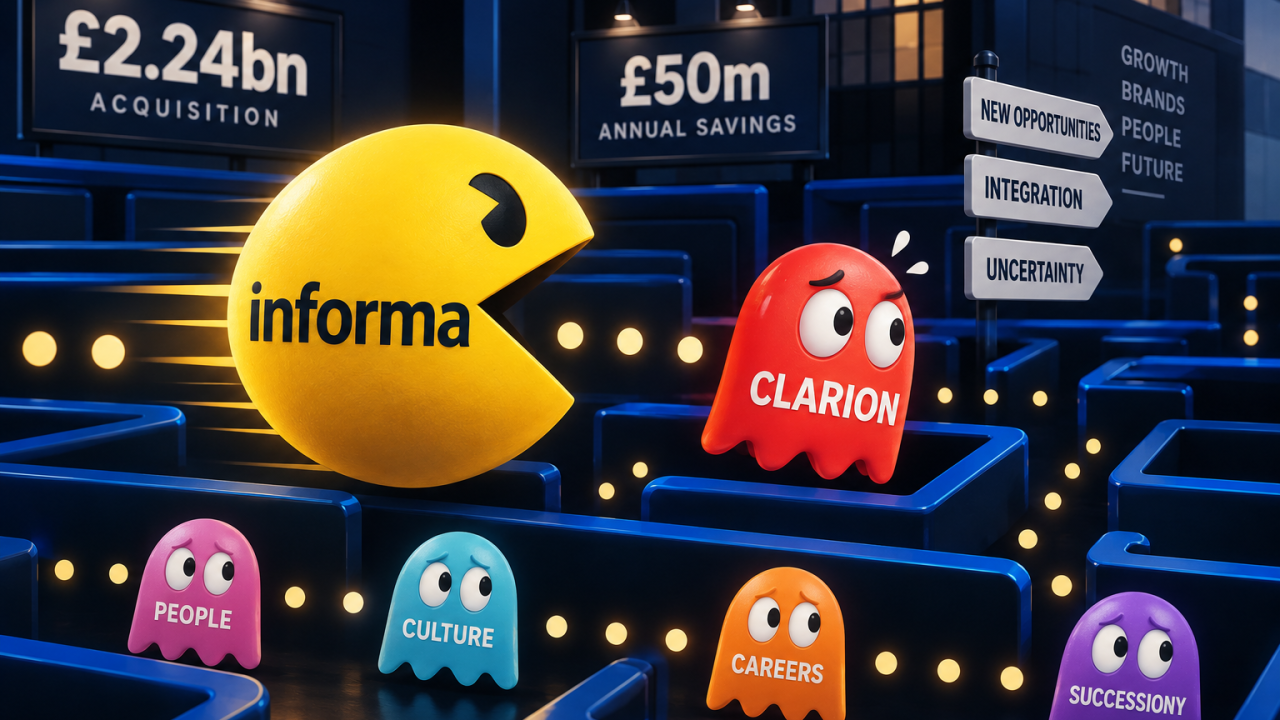
£50m.
That’s the level of annual savings Informa believes it can ultimately make by bringing the two businesses together. That was the number that made me stop, because my immediate thought wasn’t about the deal. It was about the people working at both companies and what must be going through their heads right now.
To put the scale of what’s happening into context, Informa is already the biggest exhibition organiser in the world. Clarion brings with it more than 100 B2B event brands, and once everything is brought together, Informa says its B2B Live Events business will have around 1,000 brands operating across more than 30 countries and generating something like $5.7bn a year.
That is some business.
Commercially, I can completely understand the excitement around it. But I’ve spent most of my working life dealing with the people who actually work in these businesses, so perhaps inevitably I look at an acquisition like this through a slightly different lens.
To be clear, nobody has announced £50m of redundancies and I’m certainly not suggesting that’s what is going to happen. The savings talked about cover a number of areas, including procurement, shared services, event delivery and the removal of duplicated corporate costs. There will also undoubtedly be opportunities that come from being part of a bigger organisation.
But you don’t need to have been around business for very long to understand why the word “duplication” will make some people uncomfortable.
I’ve been thinking about what it must feel like to work at Clarion at the moment. On the one hand, you’re part of an incredible success story. You’ve helped build a business that one of the biggest companies in our industry is prepared to spend billions acquiring. That doesn’t happen unless a company has great products, great customers and, crucially, great people.
On the other hand, you’re now joining an organisation that was already considerably bigger than yours and has been growing through acquisition. Informa bought Ascential’s events business, bringing the likes of Cannes Lions and Money20/20 into the group, and now another 100-plus Clarion brands are coming in too.
That creates incredible scale, but scale also creates incredible overlap.
For now, Clarion is expected to continue operating under its existing leadership while the businesses work through how they will ultimately come together. That sounds perfectly sensible, but if you’re one of the people inside the business, I imagine it also creates that slightly uncomfortable period where everything carries on as normal while nobody can completely know what “normal” will eventually look like.
That’s the part of M&A that interests me because I don’t think we always give it enough airtime. We understandably talk about valuations, multiples, shareholders, investors, market share and synergies. We discuss whether it’s a good deal and what it means for the industry. Meanwhile, the people inside the business are still getting up, going to work and trying to do their jobs while wondering what the next twelve months might look like.
Having recruited through plenty of restructures and acquisitions over the years, I know that uncertainty can be incredibly difficult. Sometimes the eventual answer is absolutely fine. A bigger business can create new roles, international opportunities and career paths that simply weren’t there before. Some people may end up with bigger jobs and better prospects as a result of this deal.
But they don’t know that yet.
If there are two people doing similar jobs across the two businesses, they’re going to wonder what happens. If there are two teams performing similar functions, people will ask the same question. When you suddenly become part of an organisation with around 1,000 brands, there are inevitably going to be a lot more people doing things that look quite similar to what you do.
There’s another side to this which I think gets overlooked as well, and that’s succession.
Clarion will have spent years developing people, giving them more responsibility and moving them through the gears. Someone might have been working towards running a show, then a portfolio, then a division. Someone else might have been identified as the natural successor to their boss and spent the last three years deliberately building the experience to get there.
Those career paths matter.
Because suddenly you bring two organisations together and the landscape changes. The job you were being developed towards might now have two, three or four people at that level or above it. There could be someone elsewhere in the new organisation with ten more years’ experience doing exactly the job you thought was your next move.
Nobody has necessarily taken anything away from you. Your job might be completely safe. But the career ladder you thought you were climbing can suddenly have a few more people standing on the rungs above you.
For me, that’s an important part of retaining good people during any acquisition. Retention isn’t only about whether somebody still has a job. It’s whether they can still see a future for themselves in the business.
And these are the same people who helped create the value everyone is currently celebrating.
Businesses like Clarion aren’t built by logos, spreadsheets or investor presentations. They’re built over years by people selling stands, creating content, running operations, looking after customers, launching shows, building teams, developing relationships and doing all the slightly bonkers things those of us who have worked in events know go into making an event successful.
None of this is a criticism of Informa or the deal itself. In fact, there could be some fantastic opportunities created by becoming part of a business with that kind of global scale. Businesses acquire businesses and part of making those deals work is inevitably finding ways of operating more efficiently.
I just think it’s possible to recognise both sides of it.
For investors, it’s a huge transaction. For Informa, it’s another major step in building an extraordinary global events business. For the industry, it potentially changes the landscape again.
But for the people who have spent years helping to make Clarion worth buying in the first place, it’s considerably more personal.
And while the rest of us talk about the deal, I suspect quite a few of them are simply wondering where they fit into what comes next.
Robert Kenward
Whether you're ready to recruit today or simply
thinking ahead, let's have a conversation.